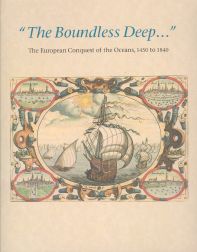
Providence: The John Carter Brown Library, 2003. small 4to. stiff paper wrappers. xxii, 204 pages. Catalogue of an exhibition of rare books, maps, charts, prints and manuscripts relating to maritime history from the collection of the John Carter Brown Library. "The Boundless Deep..." addresses the epic story of the European expansion across the ocean, beginning with the Portuguese voyages down the west coast of Africa in the middle of the fifteenth century and culminating in..... READ MORE
Price:
$8.00
other currencies
Order nr. 76280
INTRODUCTION
by John B. Hattendorf
“The Boundless Deep" is a phrase that succinctly and economically captures the sense of wonder and awe with which many have viewed the oceans. This phrase from Tennyson's “Crossing the Bar" echoes an earlier line from a sonnet by Shakespeare, who noted that neither "brass, nor stone, nor earth, nor boundless sea, but sad mortality o'ersways their power.1I Thomas Moore spoke of "this narrow isthmus twixt two boundless seas, the past, the future,-two eternities" while Byron, too, observed that "O'er the glad waters of the dark blue sea, our thoughts as boundless, and our souls as free, far as the sea can bear, the billows foam."
Mankind's enduring sense of humility and respect for the power and vast expanse of the world's oceans is the fundamental starting point in any investigation of the historical development, during the four centuries between the mid-fifteenth century and the mid-nineteenth century, of the practical ability and desire that grew among European seamen to cross the oceans. Although this process is often described as a "conquest," it is an overstatement. The great forces of nature that sweep across the oceans remain such a constant challenge that even modem sailors will agree that, in a larger sense, the sea has remained unconquered. Yet between 1450 and 1840, Europeans did succeed in using the oceans for their own purposes, but not without daunting difficulties. In the process, Europeans in the early modem period developed a wide diversity of relationships to the oceans.
Then, as today, the oceans remain a vast and dangerous region that covers the greatest part of our globe. Sailors today can easily recognize the problems that navigators faced in the age of sail, centuries ago. The fundamental problems remain the same, although, in the twenty-first century, we have much more knowledge and more sophisticated equipment to deal with the oceans, continuing to use them for our advantage and building on the experience developed from the fifteenth century onwards.
The history of maritime ventures beyond the familiar coastal waters of Europe to the west across the Atlantic and, then, into the southern hemisphere, must trace the ways in which seamen devised new technologies and adapted the most advanced understanding of their time to overcome the natural perils of the sea. In this process, ordinary seamen, who were typically among the most humble and practical of people, had to comprehend and to apply some aspects of the most advanced scientific thinking of the age.
In order to attempt voyages of discovery, one had to have some initial concept about the nature of the globe and the sky. The actual voyages would help to prove or disprove these basic hypotheses, but scientific understanding of cosmography and astronomy formed the initial basis for practical oceanic navigation and exploration. Successful crossings of the oceans were fundamentally a process of measuring the globe as a means of finding one's way from one point to another with the help of the stars. Such voyages required the application and use of advanced mathematics in conjunction with data found from measuring instruments. Yet while we can see these connections as we look back through the context of book learning and the progress of science, we must not forget the dichotomy that history illuminates: science and mathematics were fundamental to the process, but many a successful mariner preferred intuition over mathematics. Indeed, the ordinary working seaman was often illiterate. Although practical seamen often used advanced scientific ideas, they used them in a rudimentary form without fully understanding them.
While an understanding of astronomy and the skies was essential to oceanic voyaging and navigation, understanding the nature of the seas, with its winds, tides, and currents, was equally important to piloting and grew in parallel with experience in the oceans. Here, the nascent growth and gradual development of the modern physical sciences of oceanography, meteorology, marine biology, and geophysics intersected with the work of men at sea.
Voyages required huge preparations on land and in port before they could begin. Finances had to be arranged. The building materials for ships, masts, sails, and rigging had to be found and assembled, some gathered through trade from distant places. Ships' officers and sailors had to be found and recruited.