|
< 
Go back
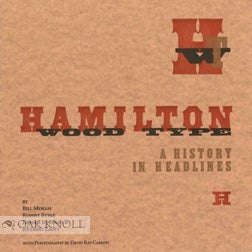
HAMILTON WOOD TYPE: A HISTORY IN HEADLINES
Moran, Bill, Robert Style, Dennis Ichiyama, and Richard Zauft
|
|
|
Hamilton began producing type in 1880 and within 20 years became the largest provider in the United States. The Hamilton Wood Type and Printing Museum is the only museum dedicated to the preservation, study, production and printing of wood type. With 1.5 million pieces of wood type and more than 1,000 styles and sizes of patterns, Hamilton's collection is one of the premier wood type collections in the world. In honor of the Museum's fifth anniversary, Blinc Publishing was commissioned to produce a 65 page book outlining the history of the Hamilton Wood Type Company, the importance of wood type to the growth of printing world-wide, and the role the Museum plays in the education of today's design professionals. The book includes a foreword by Jim Sherraden and five chapters on the history of Hamilton as a company and a museum. Well illustrated in full color. Cover is letterpress printed. Distributed for the Hamilton Wood Type and Printing Museum.
E-mail/Export ?
More On This Subject - -
> TYPE SPECIMENS, NINETEENTH CENTURY
> TYPE SPECIMENS, TWENTY-FIRST CENTURY
> UNITED STATES, WISCONSIN
> WOOD TYPE
> HAMILTON WOOD TYPE
> OAK KNOLL PRESS
> NEW
Books of related interests - -

 |
ARIEL AND MIRANDA, SEVEN WOOD ENGRAVINGS BY...INSPIRED BY...
by O'Connor, John
Printed in an edition limited to 65 numbered sets, this is one of 20 which includes an original watercolor. John S. O'Connor (1913-2004) was a student of Eric Ravilious, John Nash and others at the Royal Academy of Art in the mid-30s. His own works began to appear in the late 30's, in the publications of the Golden Cockerell Press. Since that time, Mr. O'Connor has produced paintings, watercolors, lithographs, and engravings in various media. Peppin and Micklethwait (Dictionary of British Book Illustrators, 1983, p.218) describe his wood engravings as "strikingly decorative in the tradition of Eric Ravilious, with tonal and textural contrast achieved through a wide variety of tooling." Hamilton (c1890-1990, 1994, p.150) characterizes O'Connor's landscape work as containing "strong edges, deep shadows and dramatic contrasts of light and dark" which gives "a sense of rhythm and pattern to the image." Garrett (History of British Wood Engraving, 1978, p.222) regards O'Connor's engraving style as in the "Ravilious manner," which he has aptly described (p.221) as "illustrative, decorative and dominated by intricate pattern and texture." In his introduction to this set, Mr. O'Connor discusses his interest in Shakespeare's The Tempest and provides the rationale for these engravings: "I like to consider the years previous to the brief action of the play. The "sprite" close to his master and to Miranda the child: and I suggest the boy and girl would have enjoyed each other's company in the manner of brother and sister. He would be a little wild; she enclosed in that strangely mature innocence that is written into Miranda. Shy at first, the two children would play in streams, collect herbs..." etc. There are nine illustrations: the seven signed and numbered (with regard to copy) engravings, a similarly signed watercolor on the same theme but not precisely copying any of the engravings, and a small (3x4 in.) unsigned engraving affixed to the front of the clamshell case. Figures (Ariel and Miranda, or Ariel alone) are variously posed, each partially outlined by a pure white area roughly approximating their forms. Two prints are in black, yellow, and white; the rest are black-and-white. Sizes (other than the case illustration) are roughly 4x6 or 6x8 inches. Cutouts in the fronts of the folders frame the pictures when the folders are closed. Accompanied by a folded folio sheet with title and Mr. O'Connor's introduction and signed by the artist (verso of the title page), with the annotation "92," presumably the date of publication. The interior lining of the clamshell case is printed with a repeated motif taken from one of the engravings. Printed at the Rocket Press.

|
|
|